Laman

Kamis, 15 Agustus 2013

Hair Diary || Incorporating a Protein Conditioner Into My Regimen

Time for a wash!
So a few "Hair Diary" entries ago, I talked about adjusting my regimen so that I can reach hip-length by late 2014.  In this same entry, I also discussed an experiment with a new detangling method.  (Here is that entry for those who missed it.)  So what is the update on that?  So far, so good.

Other than tweaking my detangling method, I also need to incorporate protein deep conditioning to help with length retention.  Why?  The ends of my hair are the oldest and thus most worn and susceptible to breakage.  During my first five years as a natural, I rarely (probably less than a handful of times) used protein conditioners, but that might have to change if I want to reach hip-length.  So that being said, I have been using ORS Replenishing Conditioner after the past few washes.  (This is separate from my detangling conditioner - Suave/Tresemme.)  I will report back with an update on that in the near future.

And now for some more hair pics:

Pre-shampoo treatment on the go.  Coconut-oil drenched hair in jumbo flat twists.

Mandatory shrinkage comparison.  (LEFT) Mostly shrunken wet hair.  My hair shrinks more than this once dry. (RIGHT) Stretching that same section of hair.

All done twisting.  I do not usually twist on wet hair, but I was on the go.
Planning to keep this in for 3-4 weeks.

Attempted back shot of the twist bun.

A new staple in my regimen.

My Exercise Routine for When I am Super Busy


When it comes to exercising, the biggest obstacle I face (and many others might face) is finding the TIME.  Yes, the time.  My motivation exists ...

I want to be the healthiest that I can be.  I want to keep my heart healthy.

I want to boost my mood (my happiness).
"When we exert ourselves the brain releases endorphins -- the same neurotransmitters that give us a natural high when we fall in love." ~ Dr. Timothy J. Sharp, 100 Ways to Happiness
I want to stay youthful.

I want optimize my hair growth.  (You can read more about the "theory" in this earlier post.)

I want to tone up a little (not too much ... been there and done that).

So, yes, the motivation is there, but finding the time is difficult given a busy schedule.  However, truth be told -- and I have always believed this -- we make the time for things to which we want to give time. That being said, with the time that I am able to carve out in my day, sometimes I can fit in a 30-45-minute workout and other times, all I can really devote is 10 minutes.

Hence, my interest in the "high intensity workout" craze that has been sweeping the exercise world lately.

I've tried a few here and there, but it is this one that I LOVE, have been using for a while, and recommend (after you first consult with your doctor to get the o.k.).  The video is free (available on youtube); the instructor is very clear, motivational and easy to understand; and the pace really gets your heart rate up and your muscles working.  I highly recommend stretching before and after the routine to get those muscles loose.

Rabu, 14 Agustus 2013

The Door Revolves Again: the Former White House Health Reform Czar Goes to Private Equity Firm Looking for Investments Created by Health Reform

Round and round it goes, and when it will stop, nobody knows.

Background: The Former Health Care Reform Czar's Past Career

It appears that Ms Nancy DeParle, formerly a White House Deputy Chief of Staff, and before then, from 2009 - 2011, the Director of the White House Office of Health Care Reform, has gone through the revolving door again.

We raised concerns about Ms DeParle's strong ties to the commercial side of health care at the time she was put in charge of getting health care reform legislation passed (look here.)  Specifically, her background for shepherding this legislation included being on the boards of directors of three large health care corporations, Boston Scientific, a medical device company, Cerner, a vendor of health care information technology, and Medco, and pharmacy benefits company.   She had previously been on the boards of DaVita, a commercial kidney dialysis care delivery company, and Triad Hospitals, a for-profit hospital system.  At the time, I wondered whether this set of relationships with multiple  health care corporations would lead to "health care reform" that was more about the interests of big health care corporations and their top executives than about us, the people.

As it turned out, there is a case to be made that a lot of the health care reform legislation that eventually passed was in the interests of big corporations.  It enabled for-profit health care insurance companies to continue to dominate the insurance market, and created no "public option" that could have competed with them.  It fostered the development of "accountable care organizations," (ACOs), and thus fostered a wave of consolidation in the hospital market favoring ever larger hospital systems, including for-profit ones, and the rise of the corporate physician.  It pushed the use of commercial health care information technology without requiring these devices' effects on patients to be rigorously assessed, and with no obvious concerns about the risks posed by these systems.  It did nothing to stop concentration of power in health care, nothing to support small private practices, small non-profit hospitals, or non-profit health insurance.  While it required more disclosure of conflicts of interest affecting physicians, it did nothing to reduce them, or to combat deception in health care marketing and public relations, or to reduce manipulation or suppression of clinical research to serve commercial vested interests, or even to combat blatant health care corruption.

A Brief Stop at a Think Tank

At any event, Ms DeParle left the government early this year.  She did not immediately go back to the commercial world, however.  Instead, as reported by The Hill, she went to a think tank.

Nancy-Ann DeParle, a White House deputy chief of staff and the president's point person on his signature health care law, is leaving the West Wing to join the Brookings Institution

Brookings president Strobe Talbott announced in a post on Twitter that the longtime Obama staffer would work as a guest scholar for the think tank.

Through the Revolving Door to Private Equity


That position did not last long, however.  A few days ago, a Wall Street Journal blog announced she was moving again,

As health care-focused private equity firms navigate the nuances of the Affordable Care Act, one such shop, Consonance Capital, has decided to go straight to the source, hiring Nancy-Ann DeParle, the former director of the White House Office of Health Reform.

So now she will be with private equity, and in particular, with a private equity firm specializing in, of course, health care:

Consonance has been out targeting between $350 million and $450 million for its debut fund.

The fundraising effort appears to have gained traction in recent months. LBO Wire reported in February that the firm had raised $30.3 million for Consonance Private Equity PV LP.  According to a person familiar with the fundraising, the vehicle has gathered as much as $200 million so far from investors including Ohio Public Employees Retirement System, Travelers Insurance and LGT Group.

The fund is earmarked for buyouts and recapitalizations of health-care providers, payors, pharmaceutical and specialty distributors and device manufacturers with between $20 million and $150 million in annual revenue.

Finally, it seems Ms DeParle will be suited to this new employment opportunity since she knows so much about how the new supposed health care reform will create investment opportunities,

 Ms. DeParle said the changing regulatory environment will give rise to a host of new investment opportunities. 'There’s a lot that’s changing in health care,' said Ms. DeParle. 'There will be millions of new customers for hospitals and health care providers, much stronger demand for health care services....'

Summary

So to recapitulate, Ms DeParle came from roles as a steward of multiple large health care corporations to lead the health care reform efforts of the executive branch.  In that capacity, she helped to create and enact legislation that she would later say created many "new investment opportunities."  Now, as the legislation is going into operation, she has spun over to private equity to take advantage of these opportunities.

This seems to be a great example of why the revolving door is bad for government, health care, and the American public.  People in responsible government positions, in which they are supposed to represent all the people, may be constantly thinking about impressing those who might employ them in the private sector when they leave government service.  What better way to impress these potential employers than to take actions which may later improve these companies'  commercial prospects, whatever effect they may have on us, the people?

I am no political scientist, but in my humble opinion, there should be multi year cooling off periods before someone who worked in the commercial world can get a job in a government agency whose work has direct effect on his or her previous employer or industry sector, and before someone who worked in a government agency whose work had direct effect on a particular economic sector can accept a job for a company in that sector.  Now that would be a real reform. 

Selasa, 13 Agustus 2013

AHS Talk This Saturday

For those who are attending the Ancestral Health Symposium this year, my talk will be at 9:00 AM on Saturday.  The title is "Insulin and Obesity: Reconciling Conflicting Evidence", and it will focus on the following two questions:
  1. Does elevated insulin cause obesity; does obesity cause elevated insulin; or both?
  2. Is there a unifying hypothesis that's able to explain all of the seemingly conflicting evidence cited by each side of the debate?
I'll approach the matter in true scientific fashion: stating hypotheses, making rational predictions based on those hypotheses, and seeing how well the evidence matches the predictions.  I'll explore the evidence in a way that has never been done before (to my knowledge), even on this blog.

Why am I giving this talk?  Two reasons.  First, it's an important question that has implications for the prevention and treatment of obesity, and it has received a lot of interest in the ancestral health community and to some extent among obesity researchers.  Second, I study the mechanisms of obesity professionally, I'm wrapping up a postdoc in a lab that has focused on the role of insulin in body fatness (lab of Dr. Michael W. Schwartz), and I've thought about this question a lot over the years-- so I'm in a good position to speak about it.

The talk will be accessible and informative to almost all knowledge levels, including researchers, physicians, and anyone who knows a little bit about insulin.  I'll cover most of the basics as we go.  I guarantee you'll learn something, whatever your knowledge level.

Senin, 12 Agustus 2013

63% of Physicians are "Very Enthusiastic" about "Limiting Corporate Influence on Physician Behavior," but Will Anyone Notice?

On Health Care Renewal, we have noted how the direct care of patients in the US is increasingly in the hands of large corporations, often for-profit.  We have noted the plight of the corporate physicians who swore oaths to put patients first, and now report to managers who put revenue first.

Health Care Renewal was hardly the first to raise these issues.  For years, the renowned editor emeritus of the New England Journal, Dr Arnold Relman, has been warning about the effects of the commercial practice of medicine, which once was illegal in most US states, and until 1980 was condemned by the American Medical Association (look here).

Yet in a world in which market fundamentalism (or economism, or neoliberalism) is increasingly dominant, there is little room for the view that turning health care into a business, and having the new health care businesses lead by people who are only interested in increasing short term revenue (financialization) and increasing their own compensation might be bad for patients' and the public's health.

However, close reading of a recent article suggests that many physicians "get" this problem, although may be reticent about protesting it.  

Summary of the JAMA Article

Tilburt et al authored an article published in July, 2013 that focused on physicians views about "controlling health care costs."(1)  They sent a survey to 3900 randomly chosen physicians less than 65 years old and in active practice.  2556 (65%) responded.

The survey included questions about who should be responsible for reducing health care costs, and about the physicians' enthusiasm for various means of cutting costs.  The results that got the most publicity were that physicians thought others (trial lawyers, health insurance companies, pharmaceutical and device manufacturers, hospitals and health care systems, patients, and government) were more responsible for controlling costs than physicians. 

Nonetheless, the physicians were relatively enthusiastic about potential cost control measures that would improve "quality and efficiency of care," for example, promoting 75% were very enthusiastic about continuity of care, 69% about promoting chronic disease care coordination, and  70% about "rooting out fraud and abuse."  They were also relatively enthused about "improving conditions for evidence-based decisions," for example, 51% were very enthusiastic about "expanding access to quality and safety data," and and 50% about "promoting head-to-head trials of competing treatments" (also known as a type of comparative effectiveness research).

Strikingly, however, 63% of physicians were "very enthusiastic" about "limiting corporate influence on physician behavior."  The article did not further explain that item.

An Almost Unnoticed Result

The article's results section noted "some or strong enthusiasm for improving conditions for evidence-based decisions," including "limiting corporate influence on physician behavior." It included no further comments on this issue.

The public discussion it generated largely ignored physicians' views on corporate influence..

An accompanying editorial by Dr Ezekiel Emanuel and Mr Andrew Steinmetz (2) called the survey's findings "discouraging" and chided physicians for not having an "all hands on deck" approach to controlling health care costs, stating they "must lead" on this issue, because they "captains of the ship."   It ignored the notion that the physicians may have  thought that their first responsibility was to "individual patients best interests," and thus controlling costs (especially costs that do not accrue directly to patients) should be a secondary concern.  It also belittled their enthusiasm about curbing "fraud and abuse," implying that it was "sufficiently vague" that it "may offer only modest improvements but certainly will not transform the health care system."   Instead, Emanuel and Steinmetz wanted physicians to support six strategies for transforming health care delivery, without citing evidence in support of these strategies.  The Emanuel and Steinmetz editorial ignored the physicians' views on corporate influence.


A post on the In My Humble Opinion blog by Dr Jordan Grumet in turn wondered why physicians should support "Ezekiel's fantasies about healthcare [which] are unsubstantiated."  Dr Grumet decried how particularly primary care physicians have been marginalized, and suggested that if Emanuel and Steinmetz want physicians to act like the captains of the ship they perhaps should not dictate their navigation.  But Dr Grumet apparently did not notice that physicians may realize that their captaincy has been challenged by corporate influence.  .   

Media coverage in, for example, the Los Angeles Times, Fox News, and the Pioneer Press focused on the question of whether physicians were denying a responsibility to control costs, and whether that responsibility was really theirs.  It did not comment on the issue of corporate influence.

However, so far the striking result that a large, well conducted survey showed that the majority of physicians support limiting corporate influence on their behavior remains almost completely unnoticed. 

Summary

We now have some reasonably good data suggesting that the majority of physicians are very troubled by "corporate influences" on them.

It could be that they are troubled by the most direct corporate influences, the practice of medicine by physicians who are employees of corporations, often large, and for-profit.

Dr Arnold Relman reminded us that physicians used to shun the commercial practice of medicine (look here).  Yet now increasing numbers of physicians are employees of for-profit corporations.  Physicians and other health professionals who sign on as full-time employees of large corporate entities have to realize that they are now beholden to managers and executives who may be hostile to their professional values, and who are subject to perverse incentives that support such hostility, including the potential for huge executive compensation.  It is not clear why physicians seem to be willing to sign contracts that underline their new subservience to their corporate overlords, and likely trap them within confidentiality clauses that make blowing the whistle likely to lead to extreme unpleasantness.

It could also be that physicians are troubled by slightly less direct corporate influences.  We have blogged about 
- suppression and manipulation of clinical research by corporations sponsoring such research to assess their own products and services
- deceptive corporate practices like stealth marketing of stealth lobbying
-  financial arrangements among physicians (and other health professionals) and health care corporations (e.g., drug, biotechnology and device corporations) which often seem to deliberately produce conflicts of interest meant to help market products and services, particularly the use of paid "key opinion leaders" as marketers
- institutional conflicts of interest that involve academic institutions, disease advocacy organizations, and other non-profit groups in corporate marketing and public relations

 Furthermore, stories about and criticisms of these issues remain markedly muted in the media, and even more muted in medical and health care scholarship and scholarly journals.  We have attributed this anechoic effect to individual and institutional conflicts of interest, fear of offending conflicted friends, relatives, colleagues and supervisors, and fear of offending the rich and powerful.

 Despite the anechoic effect, the article by Tilburt et al suggests that physicians want to reduce corporate influence in medicine.  Yet this evidence of physicians' discomfort with corporate influences itself has been greatly muted by the anechoic effect.

While the survey results are reminiscent of opinions I have heard from many physicians, it is striking that there is no perceptible organized movement by physicians against excess corporate influence.  At best, public expression of concerns about excess corporate influence has been muted and fragmented, often relegated to blogs and sometimes derided as coming from malcontents, dissidents, disgruntled employees, and other assorted trouble-makers.  But again it looks like the majority of physicians may (often silently) agree with these "whiners and complainers." 


Physicians need to realize that they mostly agree that to fulfill their oaths to put patients first, they have to reduce the influence of rich and powerful organizations, like health care corporations, with other agendas.  Maybe once they realize this, they will be able to start doing something to reduce such influences.  Maybe once they start, they will be able to rethink the notion that direct health care should ever be provided, or that medicine ought to be practiced by for-profit corporations. I submit that we will not be able to have good quality, accessible health care at an affordable price until we restore physicians as independent, ethical health care professionals, and until we restore small, independent, community responsible, non-profit hospitals as the locus for inpatient care.


Roy M. Poses MD on Health Care Renewal


References

1.  Tilburt JC, Wynia MK, Sheeler RD et al.  Views of physicians about controlling health care costs.  JAMA 2013: 310: 380-388.  Link here.

2.  Emanuel EJ, Steinmetz A. Will physicians lead on controlling health care costs? JAMA 2013; 310: 374-375. Link here.

Doctors now spend more time with computers than they do with patients

This bodes poorly for future physician quality:

The doctor won't see you now
DANIELLE OFRI
Pittsburgh Post-Gazette
August 11, 2013 12:03 am

Like the mail carrier or the milkman of yore, the doctor makes rounds every day in the hospital. If it's an academic institution, a bevy of medical students, interns and residents accompany an attending physician from room to room, checking up on the patient, doing a daily physical exam, reviewing the latest test results and highlighting the relevant teaching points. That's been the mainstay of medical education, and that's how my colleagues and I were taught to train the next generation of doctors.

Alas, this image would be true today only if a computer terminal were plunked in the bed instead of a patient. A new study in the Journal of General Internal Medicine confirms what any physician or patient could tell you: Doctors spend more time with computers than they do with patients. In fact, computers handily beat out patients: Medical interns spent 40 percent of their day with a computer compared with 12 percent of their day with actual living, breathing patients. (Discussing cases with other health care professionals and educational activities were the other main activities of the day.)

... Nurses are practically chained to their computers these days. A typical outpatient office visit today consists of a doctor focused directly at a screen, and a patient waiting, ahem, patiently, while the doctor thrashes it out with the computer, furiously typing notes, orders and prescriptions, occasionally whacking the side of the computer in frustration.

I can assert this is not what the EMR pioneers intended.  They intended health IT to reduce workloads and inefficiencies so clinicians could spend more time performing care.  The tools they prototyped decades ago, unfortunately, are no longer in control of, or serving, the clinicians they intended the tools to serve.  Instead they are largely serving a permanent and growing bureaucracy. 

They are, in fact, mis-serving clinicians e.g., through production of reams of legible gibberish (http://hcrenewal.blogspot.com/2011/02/electronic-medical-records-two-weeks.html), clinically mission-hostile designs (http://www.tinyurl.com/hostileuserexper), outright defects (http://hcrenewal.blogspot.com/search/label/glitch) and marauding hyperenthusiast-extremists pushing the technology on ill-informed management (http://hcrenewal.blogspot.com/2012/03/doctors-and-ehrs-reframing-modernists-v.html).

I think the illustration was appropriate; see article link for the artwork.

... For many doctors, nurses and patients, the experience of technology today--particularly the electronic medical record -- makes it feel as though technology is front and center while actual medical care is secondary. The expansion of the EMR has taken us to the point that caregivers hardly need to see a patient at all; the practice of medicine can be entirely virtual. 

It can be "virtual" if one wants low quality, that is.  Here's why:

... It was a brazen revolution in the 1890s when Sir William Osler pulled medical students out of the lecture hall and into the ward, with the startling idea that students needed to learn medicine with actual patients. But our technological march has steadily sapped this Oslerian ideal, and our trainees today are missing out on many of the finer points of medicine. Despite the impressive leaps forward in simulation technology, you simply cannot learn the subtleties of assessing a wound, palpating a spleen, asking the right questions, navigating a patient's fears, engendering trust, without actually being with patients.

Let me say this bluntly:  most people lacking full medical training cannot grasp this concept.  They do not know what they do not know.  Worse, many non-clinicians I've encountered, especially in the health IT domain, seem to be unable or unwilling will to accept that simple truth (perhaps in part due to the Dunning-Kruger effect).

... And for patients, medical care has become an increasingly isolating experience, as their caregivers seem more beholden to technologies than to their illnesses, which are most certainly not virtual.

 Perhaps decreasing patient satisfaction scores might change the current state of affairs?

... We need to rethink the role of technology in medicine, especially the electronic medical record. The new mantra of "patient-centered care" needs to apply equally to our computerized systems. With each new iteration of the EMR, we need to ask ourselves how patients are benefiting, as opposed to whether we are merely satisfying administrative documentation mandates. The EMR needs to exist in service to patient care, not simply as an end in itself.

Or, if unable to "exist in service to patient care" due to industry problems, it needs to cease to exist (i.e., be put on hold or put on ice) until it can perform to expectations.

-- SS

Minggu, 11 Agustus 2013

Who Would Have Thought, Comrades, That The Most Severe Form of Attempted Internet Censorship Could Originate in a Community Hospital, Abington Memorial, That Alleges Itself A Non-Profit Public Servant?

I would not have thought such an attempt at abridgement of fundamental American rights could originate in a local hospital, until this Motion by the defense in the EHR-related lawsuit initiated by my deceased mother in which I am now substitute plaintiff proved otherwise:


75E4/19/2013MotionBY ABINGTON MEMORIAL HOSPITAL MOTION TO PROHIBIT COMMENTARY ABOUT THIS LITIGATION TO ANY PUBLIC CONTEXT WITH MEMORANDUM OF LAW WITH SERVICE ON 04/19/2013No9267260

The hospital was attempting to have the Court issue a Motion for Prior Restraint (http://en.wikipedia.org/wiki/Prior_restraint), including against my writings here in the Healthcare Renewal blog, in a civil matter.

In my view this attempt sets a very deleterious precedent for others opposed to hospital practices.  A topic frequently discussed at this blog is imperial management.  Hospital management seems to have now become so arrogant that it apparently believes itself to have supra-Constitutional reach.  This bodes poorly for both patients' and clinicians' rights. How many other hospitals might try this, and not just against parties to litigation, hoping to get a favorable ruling?

Prior restraint (also referred to as prior censorship or pre-publication censorship) is censorship imposed, usually by a government, on expression before the expression actually takes place.

Prior restraint is often considered a particularly oppressive form of censorship in Anglo-American jurisprudence because it prevents the restricted material from being heard or distributed at all.  Prior restraint ... takes an idea or material completely out of the marketplace. Thus it is often considered to be the most extreme form of censorship.

... most of the early struggles for freedom of the press were against forms of prior restraint. Thus prior restraint came to be looked upon with a particular horror, and Anglo-American courts became particularly unwilling to approve it, when they might approve other forms of press restriction.

Excerpts of plaintiff attorney's legal response are below (full PDF of this civil document is available at http://www.ischool.drexel.edu/faculty/ssilverstein/Abington_Memorial_Hospital_PL%20response%20to%20DF%20motion%20for%20prior%20restraint.PDF).  The response was, in fact, largely right out of the U.S. Constitution.   It is stunning that a community hospital, allegedly a servant of the public, would pull the legal stunts described which seem more akin to the methods of the former Soviet Union:

... as the entirety of the blog describes, Dr. Silverstein was troubled with, and expressed his opinion that, the defendant’s counsel’s repeatedly advancing an argument [that the same attorney had made three years prior regarding a medical malpractice case in the very same hospital - ed.] that was soundly rejected by another court [related to Certificates of Merit that delayed proceedings in my mother's case for almost two years - ed.], and the defendant’s failure to reference that case in any substantive way as opposing authority, was, in his protected opinion, malicious and unethical. As above, Dr. Silverstein’s comments on the matter are, as defendant agrees, his beliefs, opinions and viewpoints, all of which are protected speech under the Pennsylvania and United States Constitutions; that defendant’s counsel is dissatisfied with protected speech is not a matter for this court to address.

I would expect the defendant's counsel was following the instructions of, or at least was in collaboration with, hospital counsel, hospital senior management and the healthcare system Board of Directors.

... Unhappy that their improper tactics are now being exposed through Dr. Silverstein’s opinions in his blog, defense counsel initially threatened litigation. Now they ask this court to enjoin Dr. Silverstein, via prior restraint, from expressing his views. This extraordinary request comes in spite of the defendant offering nothing but pure speculation as the foundation upon which they ask this Court to strip the plaintiff of his First Amendment rights.

... Their request to strip plaintiff of his First Amendment rights is at odds with the Constitution, the caselaw, and the realities of the jury selection process, which has multiple safeguards in place to remove anyone who may have read and been influenced by Dr. Silverstein’s writings. Importantly, because of the defendant’s procedural tactics, this case, while over two years old, has only just begun discovery and the jury section process is nowhere in the near future.

... The simple fact is that Dr. Silverstein’s blog contains what defendant recognizes are his “beliefs, opinions and viewpoints” and, as such, they are protected. Neither defendant nor its counsel can meet the strict requirements of their unprecedented request to strip Dr. Silverstein of his constitutional rights. Their Motion must be swiftly denied.

Dated: 28 May 2013

The court, a civil Court of Common Pleas in this county in Pennsylvania, in fact did promptly make a decision: hospital motion for censorship denied.


182
6/24/2013OrderOF 6/20/13 DANIELE,J MOTION IS DENIED; CCNo9343590


The First Amendment lives, at least in Montgomery County, Pennsylvania.

However,  as the stories aggregated on this blog and others increasingly show, hospitals' mission of public service increasingly seems to be dying.

Attempted use of courts to abridge First Amendment rights by a hospital seems like the pinnacle of abandonment of pretenses of public service and accountability.  Corporate interests come first, not patients. 

This is a reason I increasingly am of the belief that hospital management cannot be trusted.  Accordingly, in my opinion, patients - especially acute inpatients - should have 24x7, independent advocates following every aspect of their care, receiving a daily full printout of any electronic records generated, and (if legal) even using one of the many new, small video/audio recording devices in encounters with hospital personnel.

"He said/she said" is no longer an option when dealing with a Сою́з Сове́тских Социалисти́ческих Респу́блик mentality.


Click for Patriotic music!

Perhaps Abington Memorial Hospital should consider adopting the rousing music above for their HR morale-building exercises.

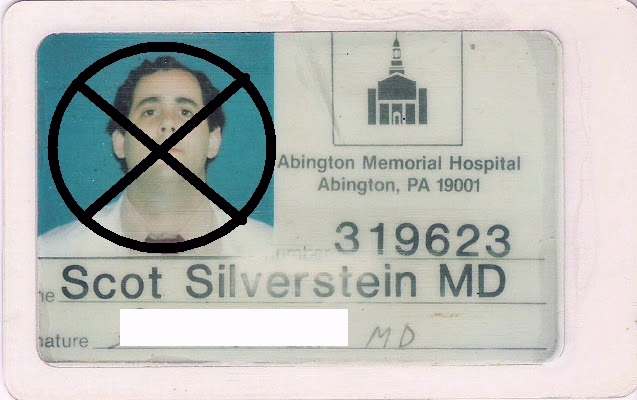
I was a Medical Resident there in 1985-87.  Like Lev Davidovich Bronshtein, I guess I've been excommunicated for failure of obedience to the Party line.


My old residency ID.  I've now been excommuncated.

Da Svedanya for now, Comrades!

-- SS