Laman

Tampilkan postingan dengan label advocacy. Tampilkan semua postingan

Sabtu, 26 Oktober 2013

Food Justice: Revisiting HEALTH

HEALTH is an organizational paradigm for Food Justice
Introduction: 
HEALTH has now been up and running for 5 years. Yay!
 

Okay, now that I've gotten the obligatory anniversary announcement out of the way, I want to draw attention back to a topic deserving of its own post:

What is "health"? What work does the acronym HEALTH perform?

In this post, I will elaborate a little bit on how I understand HEALTH after many additional years of life experience as an educator and activist, and why this understanding is preferable to the accepted definition and practice of "health." First, I will discuss the evolution of HEALTH from an organization to a blog to an experimental paradigm for coalition building. Second, I will juxtapose the self-centered normativity of "health" to the socialist politics of HEALTH. Third, I will break down HEALTH into several prerequisites and organizing points. I will conclude with acknowledging the difficulties of navigating this comprehensive vision of HEALTH and invite y'all to chime in with comments as to whether advocating HEALTH is as useful and un-problematic as I suggest.


1. The Evolution of a Vision (2005-2008)
Way back in 2005 I founded an organization on my college campus dedicated to addressing the intersections of oppressions. The club existed, on the one hand, to operate as an independent project for a course on Sustainable Buildings, and, on the other hand, to provide a much needed outlet for animal advocacy on campus. According to the original constitution submitted on April 5, 2005:
H.E.A.L.T.H. is dedicated to ecological sustainability and conservation, the adoption of compassionate and ecologically responsible lifestyles, and global awareness through activism and education. The club will work to develop an environmental taskforce for Beloit College, create and enforce environmentally sound policies, and educate the campus and community about ways to live more harmoniously with the Earth, nonhuman animals, and humans in developing countries. H.E.A.L.T.H. will be involved with nonviolent, grassroots environmental and animal activism 
HEALTH was founded upon ecofeminist philosophy, which I had begun studying independently a year before. Ecofeminism, in a nutshell, is a body of work that purports that the domination of nature (at least in the Western tradition) are entangled with the domination of women (as well as poc, working class, queers, and animals) historically, materially, conceptually, and mythologically. Ecofeminists valuably demonstrate, like other radical theories, that the oppression of humans and nonhuman beings mutually reinforce one another, and that liberation is only possible when all are free of injustices. HEALTH was conceived of this intersectional analysis.

Originally designed to address the unhealthy relationships between humans, animals, and the Earth, HEALTH would take on new meaning as an acronym during research for my interdisciplinary capstone project when I discovered the work of agrarian writer Wendell Berry and ecofeminist Chris Cuomo.

Wendell Berry's essays exemplified what thinkers like Fritjof Capra and David Orr called systems thinking. Systems thinking took into account the process, relationship, dynamism, wholeness, and complexity of "problems" (in contrast to mechanistic thinking which addressed problems by dissecting them into static, discreet parts with simple, predictable, linear cause and effect relationships. The problem with mechanistic thinking (in modern, industrial science, economics, politics, and technology) is that it often creates new problems and so it doesn't "solve for pattern."

In "Health is Membership," Berry wishes we return to the etymological root of  "health" as the whole-ness of belonging:

The word "health," in fact, comes from the same Indo-European root as ‘heal,’ ‘whole,’ and ‘holy.’ To be healthy is literally to be whole; to heal to make whole... our sense of wholeness is not just a sense of completeness in ourselves but also in a sense of belonging to others and to our place; it is an unconscious awareness of community, of having in common. (144)
[The contemporary] view of health that is severely reductive. It is, to begin with, almost frantically individualistic... One may presumably be healthy in a disintegrated family or community or in a destroyed or poisoned ecosystem.” (146)
In another essay, "Solving for Pattern," Berry discusses more concretely the destructive logic of providing health care for one group of a system at the expense of others who belong to that community in agriculture:
Our dilemma in agriculture now is that the industrial methods that have so spectacularly solved some of the problem of food production have been accompanied by ‘side effects’... the irony of agricultural models that destroy, first, the health of the soil and, finally, the health of human communities. (267)
The real problem of food production occurs within a complex, mutually influential relationship of soil, plant, animals, and people. A real solution to that problem will therefore be ecologically, agriculturally, and culturally healthful... [I]t is impossible to sacrifice the health of the soil to improve the health of the plants, or to sacrifice the health of plants to improve the health of animals, or to sacrifice the health of animals to improve the health of people. (269, 274)
Chris Cuomo provided more depth to Berry's arguments, in part by coming out of an ecofeminist tradition critical of the pastoral romanticization of the heteronormative family and settler colonialism. Cuomo offered an alternative route to addressing ecological ethics that wasn't based in mechanistic utilitarian, individualistic deontological, and apolitical care ethics. Cuomo proposed an eudaimonian ethic, based on the ancient Greek concept of flourishing, but applied to community as a social and ecological construct.
Humans cannot flourish without other humans, ecosystems, and species, and nothing in a biotic community can flourish on its own. Likewise, communities (both social and ecological) depend on the existence of other communities. Ethical objects therefore flourish as both social and ecological entities. To be extracted from community, human or otherwise, is to lack relationships and contexts that provide the meaning, substance and material for various sorts of lives.[*]
My ambition to build a coalition between clubs on campus and develop a sustainability taskforce, however, did not materialize. Several years organizing campus events and actions brought me to appreciation of how difficult it was to put this holistic perspective into practice. Such a comprehensive message and focus was naturally complex to deliver and we HEALTH spread itself thin attempting to address issues such as animal liberation and indigenous sovereignty (which I had come to appreciate after studying in Australia). Under the lack of general interest in and availability for advocacy on campus, HEALTH could not sustain itself after I graduated.


2. The Evolution of a Vision (2008-2013)
 

South Central Farm (1994 - 2006) was the largest urban farm and CSA in the USA.
When I returned home from a summer working as an educator at an animal sanctuary, I was inspired to keep my holistic vision and advocacy alive by creating a blog. Having learned from the past of how difficult it was to manage an organization that had potentially infinite possibilities, I narrowed the focus of HEALTH to a food justice blog that would encompass not only food sovereignty (which I learned the importance of through a sustainability project in my community), but also ecological sustainability, and animal liberation. The devotion of HEALTH to food justice seemed a natural fit since food is a site at which so many discourses of health (e.g., bodily, animal, ecological, communal, national) collide.

The original mission statement for HEALTH was posted on September 8, 2008:

HEALTH advocates ecological and social justice through campaigns in which the intersection of multiple oppressions in the production, distribution, and consumption of “food" can be addressed simultaneously... Health in its fullest sense cannot be achieved alone.
Over the next year, I would compile an array of resources, spanning form introductory web sites, documentary videos, peer-reviewed articles, academic journals, non-profit organizations, blogs, and books covering animal, agricultural, ecological, and social justice. Although I attempted to avoid doing so, the blog has admittedly leaned harder on the animal justice side of things. In the first two years, however, I did address matters of gender, race, class, and sexuality injustices in food production, consumption, and distribution.

One post I'm particularly fond of is "Skinny Bitch and Bulimic Vegetarians" published in April of 2009. Of all my posts, this one most directly addressed the limits of advocating personal "health" (or at least the superficial performance of health). After diagnosing the fat-shaming elements of vegan outreach (particularly the aesthetic appeal of Skinny Bitch and the PETA's campaign media), I shared my perspective on "health":

HEALTH cannot be achieved by individuals alone; true health is the consequence of an entire community flourishing mutually together. Modern reductionist approaches to health define "health" as something that can be achieved independent of Others and often at the expense of them (e.g., (over)fishing to consume more fish oil, enslaving people to pick tomatoes, wiping out wildlife to grow organic leafy greens, "curing" diseases by giving them first to millions of "animals"). Within this outlook, veg*n outreach that promotes veg*nism as good for "one's health" is playing into the liberal, antagonistic discourse of self-interest.
Since HEALTH must be achieved together it ought not, as much as possible, come at the expense of the health of Others. In this sense, appropriating mainstream means of advertising (i.e. using the promise of becoming a conventionally sexy and beautiful women) so as to exploit common insecurities over body-image (o)pressed into the minds of young women is not healthy. Exploiting, and thus perpetuating, oppression as a means to a "good" end can never be healthy, even if it promotes "health," because it ultimately subordinates the health of Others.

Read more »

Jumat, 04 Oktober 2013

Re-Assessing Animal Rights: Resources


I've been thinking about the state of the animal defense movement* quite a lot after attending four conferences on organizing this summer. Perhaps for the better, the Animal Rights 2013 conference was not one of them. The conferences I attended were either organized by and for grassroots activist or were nearly silent on the status of animal others. Never have I learned so much and been inspired more. There I was exposed to alternative interpretations of the history and politics of the US and the modern world, and there I realized how white and superficial the analyses and strategies of mainstream animal activists often are.

This post is dedicated to providing resources to those open to re-assessing the history, politics, organization, tactics, theories, and language of the animal defense movement. I intend to write more about the presentations and drama I witnessed at these conferences, but for now I want to share some essays and presentations that have really challenged and inspired me to re-think my assumptions and history of abstract theorizing that is valued in academic settings, especially in philosophy.


Re-Assessing Animal Defense
 

The History and Politics of the Animal Defense Movement
With the rise of the vegan movements, the politics of animal defense have become increasing personal that many activists have forgotten that vegan-consumption is just one strategy, and not even the most important. On the other hand, large nonprofits have taken to reforms that do not challenge the source of animal oppression: their status as commodities. Yet still, animal defense is often interpreted from the perspective of those who have made careers at nonprofits and universities--what of the history of the grassroots?


The Limits of Vegetarian Outreach
Vegetarian outreach has been a staple of the nonprofit animal defense movement since the 1990's when activists realized that over 95% of animals were killed and exploited by agribusiness. While there is much debate over how to best "sell" vegetarianism, critiques of the sufficiency of veganism as a "baseline" has been less frequent. Is vegan education our most effective tactic? Is "veganism" sufficient for animal liberation?

The Problem with Analogies to Human Oppression
Some animal activists draw logical analogies between the institutional violence against nonhuman animals and oppressed humans. The presumption is that the public will have a logical breakthrough that violence against nonhuman animals is unjust like violence against oppressed humans. Have the articulation and performances of these analogies bore the breakthroughs as activists hoped, or only further alienated them from their cause?
Critiques of Non-Profit Campaigns & Conferences
The hegemony of corporate non-profits have "hijacked" the strategy, language, and tactics of animal liberation. Non-profits generate funds and publicity for animals, however, they have also been notoriously conservative on matters of class, race, and gender in their organizations and campaigns. Their collusion with State power, capital, and white supremacy has built a large funding base, but are they building a movement upon the marginalization and oppression of humans?


The Intersections of Human and White Privilege in the ADM
The animal defense movement has continued to be the whitest social justice movements in the US for decades, despite that people of color are no less compassionate and no less likely to be vegetarian. We've already looked at colonial campaigns, analogies that alienate, under-representation in leadership, and complicity in racist law enforcement. What analytic tools, strategies, and language can whites adopt and support to build coalitions across racialized experiences?


How to Disrupt Oppression
Once equipped with more sophisticated theory and more supportive of people of color and queer leadership and projects, animal activists are on their way to building a movement that reaches beyond the single-issue identity politics of "animal rights." This is, of course, easier than it sounds. Because nearly all of us in the US have been colonised by white supremacist capitalist heteropatriarchy, it will take some effort on our behalf to challenge its "common sense" built into our brains-and-flesh. How can we resist these old habits?

Critiques of Ally, Intersectionality, and Privilege
Over the last ten years as the internet has made it easier to "call-out" animal activists for their complicity with racism and other oppressive systems, some mainstream organizations and many white activists have adopted the language of anti-oppression. Have white activists' identification as allies, acknowledgement of their privileges, and references to "intersectionality" transformed their activism or obscured privilege and power?

Are there any essays, talks, and books that have changed your advocacy for animals? Please share in the comments. I may add them to the list!

Read more »

Sabtu, 26 Januari 2013

Animal Theory Unleashed in 2013

One year ago, in recognition of a turn in animal theory over the last several years I created a post called "Animal Theory, Going Feral in 2012." The most exciting trend included advocating for animal others from critical (Critical Theory and Animal Liberation), ecofeminist (Social Lives with Animals), and citizenship theory (Zoopolis) as matters of interspecies justice in contrast to moral rights. In addition, a collection of more nuanced explorations of the ethics of human-animal relations (Animal Kind, Beyond Animal Rights, Animals in Context) as well as an unprecedented piece on plant ethics (Plants as Persons) joined the ranks of the rigorous, groundbreaking classics (Animal Liberation, Case for Animal Rights), but arguably outdated, abstract approaches.

Innovative explorations and comprehensive presentations of human-animal relations are still a comin'. The last half of 2012 and the first half of 2013 may prove to be just as rewarding as the last few. I'm particularly excited about Margo DeMello's Animals and Society, which from a glance over the table of contents seems to map a brilliant trajectory for thinking through the history, social context, and ethics of human-animal relations. Another well-welcomed book is Ryan Hedinger's Animals and War, which touches on a much neglected subject in critical animal studies: the fraternal [sic] participation and subjection of animals as agents in human warfare. Likewise, Juliet Clutton-Brock's Animals as Domesticates seems like refreshing and comprehensive examination of the history of domestication which dos not reduce animals to the role of hapless object in the popular narrative of monolithic human domination favored by advocates and adversaries of animal rights.

In addition, several books explore the construction of the modern human subject and contemporary political systems through the non-criminal violence against animal others and biopolitics of demarcating who is a proper (human) political subject. In Animalia Americana, Colleen Glenney Bogg's tracks the construction of humanity throughout American history from bestiality trials to slave narratives to contemporary feminist theory. Karl Steel's How to Make a Human excavates the violent making of "humanity" in Medieval Europe in contrast to the larger body of literature on the emergence of "humanity" in Ancient Greece and Modern England and France. There is also Cary Wolfe's work, Before the Law, which ought to attract the attention of those interested in continental political theory. And before one assumes deconstructing the border between human and animal is sufficient, consider checking out two more books dedicated to the value of plants, from Daniel Chamovitz's fascinating presentation of plant abilities in What a Plant Knows to Michael Marder's challenging Plant-Thinking.

After so many years mucking through dense theory that doesn't offer itself to political action, I'm enthusiastic for upcoming contributions on tying lived experience with animal advocacy. More than any other animal book this year, I'm highly anticipating Defiant Daughters. The book, edited by Kara Davis and Wendy Lee, focuses on a diversity of women's relationship with a diversity of animal others, including those of queers, differently abled women, and women of color. Norm Phelp's e-book, Changing the Game, genuinely addresses the inherent challenges (and differences) of advocating on behalf of animal others as well as "the rising economic, political, and cultural power of nations such as China, India, and Brazil." Finally, if you missed it, Nick Cooney's Change of Heart might be well worth a read for its presentation of empirical evidence on how to be an effective agent for change.

If you are interested in contributing a book summary and review to be posted on this blog or in the Journal for Critical Animal Studies, please send an email or comment below.

Also, please check out the updated Critical Animal Studies Resource List!

Read more »

Senin, 26 November 2012

The Limits of Vegan Consumption

Juan Karita / AP
When you transform a food into a commodity, there's inevitable breakdown in social relations and high environmental cost - Tanya Kerssen


Quinoa
A gluten-,soy-, GMO-free, complete plant protein. Half of the world's quinoa export comes from Bolivia, where 90% of the crop is grown organically, mostly on small family farms, and where growers' unions protect their livelihoods from the appropriation by multinational corporations. Beyond being an allergen-free, fairly traded, nutritional powerhouse, the increase in demand on the global market is funneling wealth into one of the poorest regions in South America. Families are being able to purchase new technologies that can reduce the stress and increase the efficiency of their farms as well as afford to send their children to university. Superfood indeed!

As successful as quinoa has become as a replacement for grains and a go-to answer to "where do you get your protein?," its success is beginning to come at a cost to indigenous ecological and cultural sustainability. In a Time article published earlier this year, Jean Friedman-Rudovsky reported a breakdown in community, "the traditional relationship between llama herding and soil fertilization," and children's SOLE food consumption.

With its entrance into the global market, quinoa has become a force of globalization. Globalization isn't merely a process that attracts wealth, it's also a process that creates an entry for western culture and technology--the good, the bad, and the ugly. The expanse and intensification of quinoa on the Andean high plains disrupts the communal grazing land of llama's, a cameloid who nourishes the harsh earth with their nitrogen-rich guano. Farmers are now competing to establish plot ownership over what has for millenia been 90% communal grazing land, with the result of seasonal kidnappings and violence as well as an increase in soil erosion and use of finite water sources. The rising affluence from the crop also leads to access to media and food once unavailable, corresponding to a change in food preferences away from the indigenous crop toward processed, malnutritious commodities. Further, the tripling of quinoa's market value may make this once local, nutritious, "mother grain" less accessible to locals not directly reaping the economic benefits.*

(Quinoa is of the most benign "cruelty-free" foods when compared to palm oil and chocolate)


"Beyond Veganism"
These less than ideal consequences that trail the otherwise mutual benefits of the global consumption of quinoa is no reason to cut the crop out of vegan diets, but it does offer an opportunity to reflect upon the limits of a consumption-centered vegan ethic (a discourse primarily about what we eat and don't eat rather than the restoration of the social responsibility we feel with all sentient beings).

While the institutional killing of chickens in the US and llamas in Bolivia go against vegan values, so perhaps too does the undercutting of food sovereignty and and biocultural diversity. There is no need to conclude that US vegans ought to condemn international food ways, nor should they finger-wag at the desire of people in the global South to share in modern technologies and western culture. What is important is to be critically engaged with the real impact our lives have on (human and animal) others, to understand that foods do not fit naturally and firmly into categories such as "good" and "bad."

The just production, distribution and consumption of certain foods vary by the methods, the place, and the time for each food. For instance, rice may a have smaller water-footprint when grown in southeast Asia and a than in California; the carbon-footprint may be higher for growing tomatoes in a local greenhouse than on a farm in Florida, but Florida tomatoes may be picked by wage slaves; people living in tundra and desert often depend upon the exploitation and killing of animal others, but by advocating an animal-free diet would force them into dependency on expensive and/or malnutritious outside food and undermine their food sovereignty. In the case of quinoa, a internationally-desired food that at first provided great benefits to Andean farmers may turn into a food that comes at the expense of the local ecology and culture.

Food is complex. General rules (like eat vegan, seasonal/local, fair, permacultural, and organic food) are important for keeping us sane, productive people. But not everyone has the privilege of living in a California vegan cooperative where SOLE food is accessible and abundant year-round. If you live in a food desert or an isolated part of the world unconductive to sustainable agriculture, one is institutionally constrained into prioritizing certain food values over others (such as cost-effectively meeting one's caloric needs with non-toxic food). Rather than simply asking those with less privilege to work towards a vegan practice, vegans can work in solidarity with other people to transforming present food systems away from not only a species hierarchy, but also class, gender, race, and national hierarchy as well. As I wrote before, "[v]eganism will have limited success so long as it remains a luxury reserved for those with privilege, independent of human liberation movements."


Food Empowerment

Read more »

Jumat, 10 Agustus 2012

Confessions from a Sanctuary

I've never shared impromptu thoughts and feelings on this blog before, but tonight is not like all other nights.

HEALTH originated out of a desire to continue my scholarship and advocacy outside of the university. While in graduate school it then became an outlet for personal research and stuff that wouldn't make it into a philosophy term paper. Presently, I've been out of school for eight months. The main difference between now and then (four years ago) is that I became burnt out between teaching apathetic students, struggling as a grad student, frustrated as a scholar, and devastated as a friend and a domestic partner. After the final brutal semester of grad school, I decided I needed new direction, one that centered around creativity and embodiment.

Six months later, I've completed a two month excursion across the West through nine of the USA's National Parks and several of its most exciting cities. Just a month ago, I arrived at an animal sanctuary whose vision is that of reciprocal healing (whereby "people" heal "animals", the animals heal people, and both heal the land). When I found it in a catalogue, it sounded like a perfect opportunity to learn more about animal care taking, therapy, and an alternative to incarceration etc. Unfortunately, this has not been so much the case. I'm going to bite my tongue on this topic and instead share something I've experienced that is much more profound and unsettling.

I. Moral Monsters
If you're on the listserve or email trail of some large animal nonprofit, you are well exposed to brutal narratives of animal cruelty. Upon seeing people kick and torment the animals, one is instantaneously engulfed in moral outrage and perhaps tears: "Those sick monsters! Those evil fuckers are going to hell! They deserve to be treated just like they've treated those poor, innocent animals!" These are just some of the reactions I've seen posted  in response to new investigative footage. For a compassionate and righteous person, these attitudes are expressed effortlessly; one must exercise willpower to hold them back.

Those bearing witness are wounded by these recorded testimonies. The trauma they experience is utter powerlessness. The powerlessness and woundedness they experience are their exposure to a will-less identification with the animal others. What makes these narratives so traumatic is the lack of mercy for those perceived as having so little power. Humans have so much power, the animals have so little, and what an injustice it is to see the abuse of human power over animal innocence.

As much as people generally identify with the animals undergoing abuse, few identify with the perpetrators of the violence. Although the purpose of these videos is to evoke empathy for the animals and consequentially political action on their behalf, the disturbing truth is that those committing the injustices are human, those bearing witness are human, and those bearing witness are often financially supporting the companies that employ these "monsters." To realize this would perhaps be another trauma, one that would move one who cared generally down one of two paths: to recognize one's participation and become veg*n or to experience intense cognitive dissonance and convince oneself that everything will be better once one of these monsters is behind bars.

Neither witness, however, is likely to place themselves in that worker's circumstance and potentially risk confronting a terrifying truth about their own nature. I would (hesitantly) agree that many of the folks in these videos who practice the most wanton cruelty are moral outliers in our society. A recent study by Amy Fitzgerald concluded that of all industrial workplaces, packing plants had the greatest rates of crimes per capita in their communities. Fitzgerald speculated her finding is based on the kind of desensitizing work of the slaughterhouse and/or the type of people who are attracted and willing to work there. Regardless, in no way should environmental conditions or personality type excuse such behavior and guard people from responsibility.

It's difficult imagining myself--an 8-year anti-speciesist from an affluent suburban background with a graduate degree--as one of these animal abusers. With all the sympathy I have for animal others, with all the theory I have learned, without any history in domestic (animal) abuse, and with experience at animal sanctuaries, identifying with these detested human beings would be a stretch. At least, so I thought until recently.

Read more »

Senin, 04 Juli 2011

Veganism as Social Somatic Response-Ability

Igualdad Animal Demonstration in Spain (www.igualdadanimal.org)
No one can deny the suffering, fear or panic, the terror or fright that humans witness in certain animals... the response to the question "can they suffer?" leaves no doubt… War is waged over the matter of pity... To think the war we find ourselves waging is not only a duty, a responsibility, an obligation, it is also a necessity... I say "to think" this war, because I believe it concerns what we call "thinking." --Jacques Derrida (1997, 2002)


The Ethics of Veganism: an Open Wound called Compassion
When I advocate veganism, I’m advocating it as recognition of a phenomenon, not as a prescription of a principle. That is, veganism is a recognition of the human condition of finitude, fallibility, and meagerness in a universe shared by other finite, fallible, and meager beings. As I wrote before, veganism as a social existence with animal others is not a foreign attitude. Rather, it is a mode we are “thrown into” when we become subjected to our own curiosity and compassion for other mortal creatures. Recognizing veganism as such holds us responsible to animal others’ interests, and holds us accountable for closing off this mode for relating to animal others as “killable” instruments for some so-called higher-value (i.e. profits, “life,” “humanity”). Thus, veganism as a social attitude motivates and is facilitated by vegetarian consumption. Veganism-vegetarianism are the means and the end of a non-exclusive social responsibility.

Veganism is therefore not the application of a principle of obligation, but the phenomenon of obligation from being addressed by the animal other to respond in return as a social being. I’m not saying that a pig or salmon speak to us or voice themselves as a human might, but that we experience the phenomenon of being addressed, being called to ourselves as social and ethical beings, by recognizing the others’ different perspective, interests, and shared vulnerability. This phenomenon is with us from infancy. Just watch the expression of wonder watching the expressions of other species. It’s similar to their gaze into the face of a human. Children are not born distinguishing the moral considerability between humans and many other animals. Just recently, psychologists Patricia Hermann and others found that anthropocentirsm is a perspective acquired around the age of five, not something innate.

The veganism I advocate fits well with Ralph Acampora articulation of ethics as a phenomenon of the body’s existence as an ecologically and socially interrelational being in contrast to popular thought that ethics is the product of transcendental principles of pure reason or codes intersubjectively consented to. Reason may be valuable in that it exposes latent prejudices and inconsistencies in how one treats others, but only by presupposing our existence as social, caring, vulnerable, and potentially violent bodies. From an ethical paradigm of the interrelational lived body, the “burden of proof” is not placed upon veganism as an extension of ethics, but rather the “ethical isolationism or contraction” of a an ethics based upon self-interest.

For example, reflect upon the times when reason has been used not as a preventative measure against violence and prejudice, but as an instrument against our sociality with and care for others (e.g. “just war,” “ethnic cleansing,” “honor killings,” vivisection etc). It is through manufacturing a code and imposing it upon the world that we can justify acting violently toward others because of the class we place them into. Arguments for fending off veganism and vegetarianism are usually no more than an elaborate game of logic to preserve one’s power and privilege over others by making violence reasonable. They defy our underlying capacity to recognize others as social beings.


Humanism's Double Standard: The Unreasonableness of Consistency
Veganism is the immanent, not the abstract, relationship we have to animal others as social beings. Although my description of veganism is abstract in form, in practice, the reasons we assign to violence are the abstractions. Animal others are exploited under the justification that they belong to a separate race we’ve created and called “animals,” and they are institutionally exploited for the good of something we call “civilization” and the “economy” for something called “capital.”
Read more »

Jumat, 03 Juni 2011

A Critique of Consumption-Centered Veganism

INTRODUCTION: The mainstream discourse and practice of veganism as an individual’s (abstention from the) consumption of animal products, I believe, is problematic in three interrelated ways: practically as an economic boycott, socially as a privileged consumerism, and philosophically as an equivocation with a vegetarian lifestyle. I propose a new understanding of veganism as a social modality with and in regard to animal others which can be distinguished from and exist independently of vegetarian consumption. However, this distinction does not so much as invalidate vegetarian consumption so much as place it in a dialectic relationship with veganism, in which it can be regarded as a valuable means, but not an end.


PRACTICALLY, positioning veganism as an economic boycott is a very limited tactic given the prevalence of global capitalism. Mainstream veganism only addresses the content (i.e. animal products) and not the form/structure (i.e. capitalism) of the global market that facilitates the exploitation of animals as commodities and obstructs people from transforming society. This is evident in several ways.

First, many mainstream vegans tend to regard the very culprits of animal exploitation as the remedy. Veganism is now sold to people in the form of products (sometimes explicitly labeled “vegan”) by the very corporations (i.e. Kraft, Dean, Con-Agra, Burger King, etc.) that exist and profit off the exploitation of animals. While the availability and convenience of these products is celebrated as “victories,” their support only sediments the control these corporations have over the market and government. These agri-businesses that own, produce, and distribute most of our food supply have tremendous political power winning government subsidies and combating policy changes that would abolish animal exploitation practices..

Second, even if consumer vegans extend their boycott from the individual product consumed to the company who profits from it, without also challenging the present political-economic order of capitalism in which the interests of corporations persistently trump the interests of the general public, vegans remain complicit in the system that entitles businesses to exploit animal others (and human others as well). Besides, it’s not as if animal agribusiness is an isolated phenomenon; it is sustained by what Barbara Noske calls “the animal industrial complex”—an amalgamation of feed and chemical companies, the pharmaceutical industry, representatives and officers in government, public research and educational institutions etc. that are all mutually dependent upon one another through capital. Animal agribusiness will not be overthrown until these regimes and what gives them power are transformed. Even if consumer vegans were able to make significant dents in the national market, all this will be reversed by the rise of the affluent animal-eating class in the developing world to whom animals raised nationally will be exported, or—in “a race to the bottom”— to where the industry will be exported—displacing farmers and wildlife and externalizing production costs upon their communities.

Third, veganism as an economic boycott does not even universally enable people to practice veganism. Since wholesome food is regarded as a commodity rather than a socio-political right, large populations of disadvantaged people have little to no financial and/or geographic access to vegetarian food and goods, and thus are severely disadvantaged from living a secure vegan life. Food will continue to be grown for profits before people’s needs and preferences so long as food remains a commodity. A vegan world will not be brought about by the asocial, amoral market but by people in what Vandana Shiva calls “food democracy”—when food production and access is determined by people, not the imperialism of the market. In sum, mainstream vegan discourse and activism's focus on economic boycott is problematic not because it is ineffective, but because it is insufficient. Without challenging the political, economic, and social structure of society, veganism as a movement will make little progress reducing and abolishing animal exploitation.

Read more »

Minggu, 16 Januari 2011

Decolonization and Animal Liberation: Love, Violence, Becoming-Other-Wise

Beehive Design Collective. "FTAA." Source: www.beehivecollective.org
Introduction
Some cyber-friends have been pestering me to put up another blog post since I haven't posted anything in three months--well, maybe that's an exaggeration but i really wanted to use the word pestering--, so  I'm posting two abstracts I recently submitted to the Thinking About Animals conference at Brock University (St. Catharines, ON, Canada) going on between March 1 and April 1, 2011. This will be the 10th Critical Animal Studies conference, and Brock is perhaps one of the most deserving universities since its establishment of a critical animal studies minor and an official vegan policy in the Sociology department.

On that note, I encourage you to check out the Critical Animal Studies resource page I created over winter break!!!

The first paper, on Frantz Fanon's The Wretched of the Earth, is a paper I wrote for Existentialism in the Fall. I went through some angst writing it, but came out overall satisfied with the paper. If any of you are interested in reading it, I'll send you a copy in exchange for some good feedback. The second paper ought to be more familiar to avid readers of this blog. It's basically a summation of what I have written on the understanding of veganism over the last two years or more.

1.
Decolonization and Animal Liberation:
Violence and Becoming-Animal in Frantz Fanon’s The Wretched of the Earth
In 1961, the Algerian psychoanalysist, Frantz Fanon, published, Les Damnés de la Terre, a book specifically about the revolutionary movement in French Algeria, but a guide to decolonization in general. In The Wretched of the Earth, Fanon gives a phenomenological account of the Algerian independence movement, from its inception in local, spontaneous violent uprisings, to a national political movement, to the development of a national culture and new humanism. For Fanon and his friend Sartre, violence is a necessity for the colonized to become fully human and political subjects. Similarly, the development of a national culture is necessary development for not only the liberation of Algeria, but for the future of humanity.

While Fanon’s primary goals are the achievement of national consciousness and a new humanism, a subversive reading of this text foregrounds “the animal” that beseeches his description of decolonization. Fanon’s characterization of the relationship between decolonization and animals is complex: on the one hand, animal being is to be transcended, if not negated through self-assertion and violence, yet the animal virtues of spontaneity, ferocity, and pack-forming are crucial for the overthrow of the colonizers. If humans’ metaphoric relationship to “animality” and animal others materialize in their relationship with one another, as is argued, then decolonization will not be achieved so long as a hierarchical and exclusionary identity politics exists between human and animal others (as is inferred by Fanon and Sartre’s subject-centered humanist discourse). It is argued that the anarchistic process of “becoming-animal” described by Gilles Deleuze and Félix Guatarri is a more transformative and promising alternative to humanism for not only human liberation, but also the liberation from humanist violence against “animality” and animal others.

2.
Deconstructing Veganism:
Love, Listening, Conversations, and Companionships Beyond Boundaries
For over a decade, Gary Francione (1996, 2008) has been championed for his bold challenge to the efficacy of “new welfarism” and the sufficiency of lacto-ovo-vegetarian advocacy in the contemporary “animal rights” movements. Yet relatively few animal abolitionists have ever challenged the sufficiency and status quo of veganism. In a time when neoliberalism has come into a greater appropriation of veganism (Hammer 2008), real animals have become absent from the discourse of many animal and vegan advocacy campaigns (Adams 2006), and to be a vegan is more about one’s way of life (i.e. the subculture one belongs to) than one’s actual relationship to animals, a more radical critique of not only vegetarianism but veganism too is needed.

While many celebrate the mainstreaming of veganism, I would like to caution self-identified vegans and animal activists from accepting the present understanding of vegan as an identity of (abstention from) consumption. The present understanding of veganism as a) an identity b) defined negatively as an abstention from c) consumption has lead to a certain modality of political and private life which has been legitimately accused of self-righteousness, identity politics, militancy, colonialism, and privileged consumerism. In light of this, we are called to a radical rethinking of veganism not as a noun (“ vegan”) to be identified with, purchased, consumed, and completed, but as a modality and relationship with others that is never yet complete.

Veganism is something to be understood affirmatively, as an affirmation of our own feelings and the voices of others. Those who have come into veganism as a liberation project must adamantly recall that they did not do so because of convenience, out of tradition, or merely out of pleasure, but because they are in search of affirming love. This love must never be forgotten as their point of departure and arrival. The ends of veganism are in the means of not forgetting, disavowing others. It is through disavowal that people commit the most violence by ignoring their own and others’ sentiments; they wage war on themselves and others for foreclosing ends, ideals, and identities, rather than waging conversation. The end of veganism is thus not to become a vegan, but to become other-wise in conversations and companionships beyond boundaries and “language.”

Read more »

Minggu, 29 Agustus 2010

Moving Animals: Spectacular Animal Films (Part 2)

3. The Animals Film (Beyond the Frame 1981, 137min)

To my knowledge, The Animals Film was the first documentary to me made on the animal protection movement and the first to be aired on public television--an amazing feat given that it was released just 6 years after the publication of Animal Liberation, 1 year after Henry Spira's ad campaign against Revlon, 2 years before The Case for Animal Rights, and 3 years before Unnecessary Fuss. Filmed in the United States by an Israeli and released in England, TAF had been the most comprehensive film on animal welfare up until the release of Earthlings 16 years later. Yet, despite its age, sadly, little has changed since its release except that industry practices and problems have increased in magnitude and extended into other countries. (In 1980, about 5 billion animals were slaughtered in America annually compared to nearly 9 billion by 2000). In fact, it is my opinion that despite the praise for Earthlings and the absence of knowledge about this film, TAF is better. (Whether it is more effective at recruiting vegans--Earthlings supposedly is nicknamed "the Vegan maker"--, that is for empirical studies to determine).

Read more »

Sabtu, 28 Agustus 2010

Moving Animals: Spectacular Animal Films (Part 1)

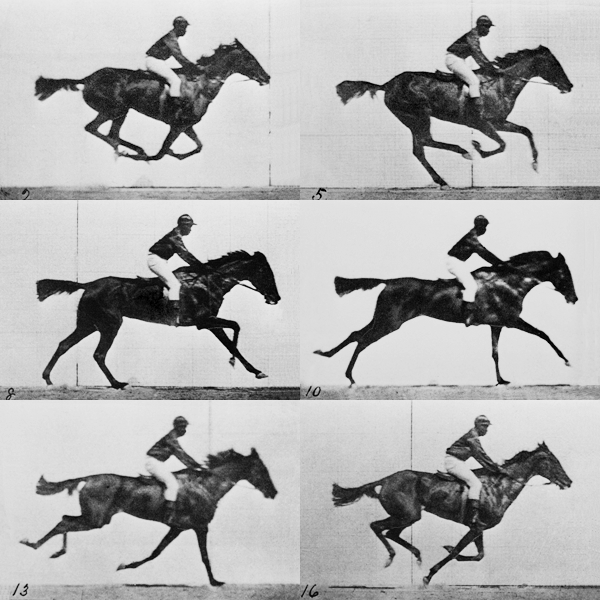
Eadweard Muybridge's "The Horse in Motion" (1878)
"Animals: The Most Moving Things in the World"
--Jim Mason in An Unnatural Order (2005 [1993])

“The animal look can be seen as a continuation of the photographic look... Animals appeared to merge with technological bodies that replaced them... If the animal cannot die but is nonetheless vanishing, then it must be transferred to another locus, anther continuum in which death plays no role... the cinema developed, indeed embodied, animal traits as a gesture of mourning for the disappearance of [animals]"
--Akira Lippit in Electric Animal (1998)


Moving Animals, Animal Affect, and Effective Movies
Since its inception, the animal movement has relied upon images to evoke sympathy--from William Hogarth's "The Four Stages of Cruelty" (1751) that connected cruelty to animal to cruelty to humans, to the anti-vivisectionist posters that re-figured the medical oppression of women to that of animal others, and PETA's "Holocaust on Your Plate" and "Animal Liberation" exhibits that juxtaposed images of human and nonhuman oppression. Undercover investigation footage of labs, in particular, played a crucial role in the 1980's, especially within the efficacy of the ALF and PETA (videos like Unnecessary Fuss and Inside Biosearch). However, with increased vandalism and exposure, the Animal Industrial Complex has been vigilant to guard its practices from public knowledge. Since the 1990's, these industries have installed hi-tech security systems in addition to lobbying for the Animal Enterprise Terrorism Act [AETA], which gained increasing government backing post-9/11. Such footage, has been crucial to educating the public about animal welfare within the age of televisions, computers, and cinema. Over the last decade, activists have even accompanied themselves with video harnesses to literally carry the animals' voices to protests and demos.

Read more »

Rabu, 16 Juni 2010

Vegan logos, 11 Reasons

So I was recently asked by someone why I was vegan. Oddly, this hadn't been something I had thought about recently, so I decided to go through my reasoning. I wanted to keep it short, but you know me! The point is, I'm trying to capture the bigger picture within a linear narrative that, while simplified, still captures some nuance. Let me know what you think I may turn this into a pamphlet. Am I missing something?

1. Nonhuman animals are sentient
2. Nearly all animals raised for food today suffer tremendously.
3. The problem is institutional and of use, not merely cruelty.
4. Discrimination and Contradiction.
5. Killing animals for food involves either self-deception or habituation to violence.
6. Meat is a symbol and legitimator of power and hierarchy.
7. One cannot meet the global demand for meat while fairly feeding the world.
8. The current world consumption of animals is unsustainable.
9. Veganism is the practice of social and ecological justice.
10. It doesn’t matter whether eating animals is natural.
11. Veganism is fun and delicious!
Read more »

Minggu, 06 September 2009

Veganism as Intersectional Social Justice (part 1)

Introduction
Would any sane person think dumpster diving would have stopped Hitler, or that composting would have ended slavery or brought about the eight-hour workday...Then why now, with all the world at stake, do so many people retreat into these entirely personal “solutions”?--Derrick Jensen[*]

[Oppressions are ideologies—]“a set of socially shared beliefs that legitmates an existing or desired social order. Prejudice, on the other hand, is an individual predisposition to devalue a group of others… speciesism is also an ideology—that is, a set of widely held, socially inherited beliefs… When the psychological and moral (or immoral) bases of oppression are accentuated, social structural forces are downplayed or overlooked entirely… they tend to stifle any realization of the need for social change.” –David Nibert[*]

The discourse of vegetarian and vegan advocates is saturated with personal choice. Perhaps more persistently than any other social justice movement in America today other than the pro-choice movement, animal defenders emphasize the individual: the individual animal who suffers, the individual person who chooses three times a day to choose compassion over cruelty, the individuality of the movement, etc.

It is the individual who is responsible for the suffering of each individual animal because of some irrational prejudice. If only these people were just more enlightened about animal sentience, about nutrition, they would leave cruelty-free lives. It is also the individual who is responsible for world hunger because they selfishly feed the world’s grain to livestock. If only each individual chose a vegetarian lifestyle, there would be enough food for everyone.

When the individual person is not totally responsible for the suffering of each individual animal, it is because vegetarianism is too inconvenient and the law is too permissive of cruelty. If only restaurants and grocery stores offered more vegetarian foods (especially faux-meats), people would stop eating meat. If only there were stricter penalties for animal cruelty, less people would harm animals and there would be more justice. Thus the irony of the dominant discourse is that animal liberation is possible so long as humans become more rational and less self-interested; but, so long as people are self-interested, we ought to make vegetarianism as convenient and non-threatening as possible and make animal cruelty as inconvenient and punishable as possible.

In this post I will lay-out the myriad of ways the most popular forms of animal advocacy (at least in the USA) privileges a white, middle-class audience at the expense of including people of color and people of low-income. Drawing on the vast, original works over at The Vegan Ideal [TVI], I wish to demonstrate 1) how focusing on punishing, shaming, and dehumanizing individual animal exploiters a) draws attention away from the institutional oppression (i.e. speciesism) in favor of vice (i.e. cruelty) as well as b) how such punishment is often part of ethnocentric and nationalist projects, and finally, c) how such projects merely seek to substitute human cages for animal cages.

Further, I would like to point out 2) how focus on individual action and lifestyle changes often centers around "voting" with one's dollar, which a) privileges the middle-class at the expense of marginalizing low- and no-income classes, b) privileges non-profit dissemination of literature at the expense of real social organizing and mobilization that empowers people and communities, and c) encourages conservative discourse by said non-profits that target "mainstream" audiences with money that can be used to support said kind of campaigns.

Read more »

Selasa, 14 April 2009

Skinny Bitch and Bulimic Vegetarians

Introduction
In 2007, few people would have expected a "no-nonsense" book of "tough-love" for American females to become one of the most successful vegetarian advocacy publications in the Western hemisphere. This book, Skinny Bitch, spawned a whole slew of products including a cookbook, an instructional book on pregnancy, a journal, and now three work out videos. Already, the original book has become an international bestseller, hung onto the New York Times bestseller list (including a brief spot at the top), has sold two million copies, and has been translated into 20 languages.

While many vegetarian and AR activists have welcomed this book with open arms, too few people have heeded to the criticisms that this book preys on female body insecurities. Below, I will discuss why disguising a vegetarian message within a frame about weight-loss/management is not only detrimental to the health of adolescent females and young women but also trivializes the radical political orientation of veganism by conflating it with a self-interested, faddish diet. In light of continuous research that links the adoption of vegetarian diets by teens to disguise and/or justify their eating disorders, the sizist discourse that shames and blames "fat" people, and the vogue-ing of vegetarianism for the mainstream, I suggest that vegans ally instead with feminist and radical social justice groups to promote body acceptance and HEALTH rather than societal acceptance and "health."
Read more »

Jumat, 14 November 2008

Privilege: The U.S. Vegan Movement, Whiteness, and Race Relations (part 1)

Introduction
My aim in this series on privilege is to examine the (not so) invisible whiteness of the “vegan” movement. In the subsequential posts, I hope to educate fellow advocates who have not thought much, if at all, about white privilege and how it not only ostracizes vegans of color, but also alienates potential vegans and allies from joining the movement. The first post in this series will focus on one of the most controversial (and obvious) demonstration of race-relations gone wrong, then the following ones will delve more into the dynamics in everyday vegan advocacy.

“Are Animals the New Slaves?”

In the summer 2005, People for the Ethical Treatment of Animals [PeTA] began a traveling exhibit entitled "
The Animal Liberation Project" [NOTE: This is an updated version of the ALP. Also see the UK versions] in which it was asked, “Are Animal the New Slaves?” The original exhibit, composed of images from the Cambodian genocide, exploitative child labor practices, and enslaved and lynched American slaves to photos of nonhuman animal bodies in like contexts, attempted to manifest the conceptual connections between the oppression of human groups and the oppression of animals in the minds of its audience. However, after only a month on the road, the exhibit was suspended after major outrage ensued in New Haven, Connecticut.

Not only did students begin shouting at PeTA’s staff that the exhibit was racist, but predominant Afro-American organizations joined in the outrage at the juxtapositions being made. For instance, Scott X. Esdaile, the president of the regional NAACP, arrived at the exhibition in order to demand its removal. He declared that “[o]nce again, black people are being pimped. You used us. You have used us enough." [
1]

Vakiya Courtney, executive director of America’s Black Holocaust Museum was particularly outraged, as Dr. James Cameron, the founder of the museum, was one of the men in a noose being juxtaposed to slaughtered steers. "How can you possibly compare the brutality that our ancestors... that people like Dr. Cameron had to overcome," she asked, "to animal cruelty?" [
1]

Dr. Cameron, the only living survivor of a lynching in America, acknowledged that he was "treated like an animal" at the beginning of the century, but that "there is no way we should be compared to animals today… You cannot compare the suffering… I experienced to the suffering of an animal." [
1]

In response to one person’s outrage, Ingrid Newkirk, the president and cofounder of PeTA, wrote that she can and should make such comparisons despite the outrage of millions of Afro-Americans “because it is right to do so and wrong to reject the concept. Please open your heart and your mind and do not take such offense” [
2]. While PeTA’s exhibit may have been created with good intentions, Newkirk’s remarks, on the contrary, were strikingly insensitive toward the Afro-American community whose ancestors were enslaved not 150 years ago and who still to this day struggle with dehumanization and subordination in America. Later, Newkirk went on to "unequivocally apologize for the hurt" after realizing that "old wounds can be slow to heal and for not helping them to heal, I am sorry." [1*] The NAACP spokesperson, John White, in response to Newkirk's decision to continue the project said simply, "I'm not surprised." [1*]
Read more »