Laman

Rabu, 30 Maret 2011

Dr. Kevin Patterson on Western Diets and Health

A few readers have pointed me to an interesting NPR interview with the Canadian physician Kevin Patterson (link). He describes his medical work in Afghanistan and the Canadian arctic treating cultures with various degrees of industrialization. He discusses the "epidemiological transition", the idea that cultures experience predictable changes in their health as they go from hunter-gatherer, to agricultural, to industrial. I think he has an uncommonly good perspective on the effects of industrialization on human health, which tends to be true of people who have witnessed the effects of the industrial diet and lifestyle on diverse cultures.

A central concept behind my thinking is that it's possible to benefit simultaneously from both:

  • The sanitation, medical technology, safety technology, law enforcement and lower warfare-related mortality that have increased our life expectancy dramatically relative to our distant ancestors.

  • The very low incidence of obesity, diabetes, coronary heart disease and other non-infectious chronic diseases afforded by a diet and lifestyle roughly consistent with our non-industrial heritage.

But it requires discipline, because going with the flow means becoming unhealthy.


Sabtu, 26 Maret 2011

Randy Tobler Show: Welcome

This morning, I had a conversation with Dr. Randy Tobler on his radio show "Vital Signs", on 97.1 FM News Talk in St Louis. Dr. Tobler is an obstetrician-gynecologist with an interest in nutrition, fitness and reproductive endocrinology from a holistic perspective. He asked me to appear on his show after he discovered my blog and found that we have some things in common, including an interest in evolutionary/ancestral health. We talked about the history of the American diet, the health of non-industrial cultures, what fats are healthiest, and the difference between pastured and conventional meat/dairy-- we took a few questions from listeners-- it was fun.

The show is available as a podcast here (3/26 show), although as far as I can tell, you need iTunes to listen to it. My section of the show starts around 8:20.

To everyone who arrived here after hearing me on the air this morning: welcome! Here are a few posts to give you a feel for what I do here at Whole Health Source:

The Coronary Heart Disease Epidemic

US Weight, Lifestyle and Diet Trends, 1970-2007
Butter vs. Margarine Showdown
Preventing and Reversing Tooth Decay
The Kitavans: Wisdom from the Pacific Islands
Potatoes and Human Health, Part I, Part II and Part III
Traditional Preparation Methods Improve Grains' Nutritional Value
Real Food XI: Sourdough Buckwheat Crepes
Glucose Tolerance in Non-industrial Cultures
Tropical Plant Fats: Palm Oil

It's Time to Let Go of the Glycemic Index

Rabu, 23 Maret 2011

Safflower Oil Study

A few people have sent me a new study claiming to demonstrate that half a tablespoon of safflower oil a day improves insulin sensitivity, increases HDL and decreases inflammation in diabetics (1). Let me explain why this study does not show what it claims.

It all comes down to a little thing called a control group, which is the basis for comparison that you use to determine if your intervention had an effect. This study didn't have one for the safflower group. What it had was two intervention groups, one given 6.4g conjugated linoleic acid (CLA; 50% c9t11 and 50% t10c12-CLA) per day, and one given 8g safflower oil. I have to guess that this study was originally designed to test the effects of the CLA, with the safflower oil group as the control group, and that the interpretation of the data changed after the results came in. Otherwise, I don't understand why they would conduct a study like this without a control group.

Anyway, they found that the safflower oil group did better than the CLA group over 16 weeks, showing a higher insulin sensitivity, higher HDL, lower HbA1c (a marker of average blood glucose levels) and lower CRP (a marker of inflammation). But they also found that the safflower group improved slightly compared to baseline, therefore they decided to attribute the difference to a beneficial effect of safflower oil. The problem is that without a control (placebo) group for comparison, there's no way to know if the improvement would have occurred regardless of treatment, due to the season changing, more regular check-ups at the doctor's office due to participating in a study, or countless other unforeseen factors. A control group is essential for the accurate interpretation of results, which is why drug studies always have placebo groups.

What we can say is that the safflower oil group fared better than the CLA group, because there was a difference between the two. However, what I think really happened is that the CLA supplement was harmful and the small dose of safflower oil had no effect. Why? Because the t10c12 isomer of CLA, which was half their pill, has already been shown by previous well-controlled studies to reduce insulin sensitivity, decrease HDL and increase inflammatory markers at a similar dose and for a similar duration (2, 3). The safflower oil group only looked good by comparison. We can add this study to the "research bloopers" file.

It's worth noting that naturally occurring CLA mixtures, similar to those found in pastured dairy and ruminant fat, have not been shown to cause metabolic problems such as those caused by isolated t10c12 CLA.

Jumat, 18 Maret 2011

New Ancestral Diet Review Paper

Pedro Carrera-Bastos and his colleagues Maelan Fontes-Villalba, James H. O'Keefe, Staffan Lindeberg and Loren Cordain have published an excellent new review article titled "The Western Diet and Lifestyle and Diseases of Civilization" (1). The paper reviews the health consequences of transitioning from a traditional to a modern Western diet and lifestyle. Pedro is a knowledgeable and tireless advocate of ancestral, primarily paleolithic-style nutrition, and it has been my privilege to correspond with him regularly. His new paper is the best review of the underlying causes of the "diseases of civilization" that I've encountered. Here's the abstract:
It is increasingly recognized that certain fundamental changes in diet and lifestyle that occurred after the Neolithic Revolution, and especially after the Industrial Revolution and the Modern Age, are too recent, on an evolutionary time scale, for the human genome to have completely adapted. This mismatch between our ancient physiology and the western diet and lifestyle underlies many so-called diseases of civilization, including coronary heart disease, obesity, hypertension, type 2 diabetes, epithelial cell cancers, autoimmune disease, and osteoporosis, which are rare or virtually absent in hunter–gatherers and other non-westernized populations. It is therefore proposed that the adoption of diet and lifestyle that mimic the beneficial characteristics of the preagricultural environment is an effective strategy to reduce the risk of chronic degenerative diseases.
At 343 references, the paper is an excellent resource for anyone with an academic interest in ancestral health, and in that sense it reminds me of Staffan Lindeberg's book Food and Western Disease. One of the things I like most about the paper is that it acknowledges the significant genetic adaptation to agriculture and pastoralism that has occurred in populations that have been practicing it for thousands of years. It hypothesizes that the main detrimental change was not the adoption of agriculture, but the more recent industrialization of the food system. I agree.

I gave Pedro my comments on the manuscript as he was editing it, and he was kind enough to include me in the acknowledgments.

Senin, 14 Maret 2011

Gluten-Free January Survey Data, Part II: Health Effects of a Gluten-Free Diet

GFJ participants chose between three diet styles: a simple gluten-free diet; a "paleo light" diet diet that eliminated sugar and industrial seed (vegetable) oils in addition to gluten; and a "paleo full monty" diet that only included categories of food that would have been available to our pre-agricultural ancestors. The data in this post represent the simple gluten-free diet group, and do not represent the other two, which I'll analyze separately.

To get the data I'll be presenting below, first I excluded participants who stated on the survey that they did not adhere to the diet. Next, I excluded participants who were gluten-free before January, because they would presumably not have experienced a change from continuing to avoid gluten. That left us with 53 participants.

For each of these graphs, the vertical axis represents the number of participants in each category. They won't necessarily add up to 53, for several reasons. The most common reason is that for the questions asking about changes in health conditions, I didn't include responses from people who didn't have the condition in question at baseline because there was nothing to change.

Question #1: What is your overall opinion of the effect of gluten free January on you?

Participants had a very positive experience with the gluten-free diet. Not one person reported a negative overall experience.

Question #2: Did you note a weight change at the end of gluten free January?

And here are the data for people who described themselves as overweight at baseline:

Two-thirds of people who were overweight at baseline lost weight, and only one person out of 37 gained weight. That is striking. A number of people didn't weigh themselves, which is why the numbers only add up to 37.

Question #3: Before January 2011, did you have a problem with intestinal transit (frequent constipation or diarrhea)? If so, did your symptoms change during the month of January?


Responses are heavily weighted toward improvement, although there were a few instances where transit worsened. Transit problems are one of the most common manifestations of gluten sensitivity.

Question #4: Before January 2011, did you have frequent digestive discomfort (pain, bloating, etc.)? If so, did your symptoms change during the month of January?


Digestive discomfort was common, and the gluten-free diet improved it in nearly everyone who had it at baseline. I find this really impressive.

Question #5: Before January 2011, did you have acid reflux? If so, did your symptoms change during the month of January?

Acid reflux responded well to a gluten-free diet.

Question #6: Before January 2011, did you have a problem with tiredness/lethargy? If so, did your symptoms change during the month of January?
Lethargy was common and generally improved in people who avoided gluten. This doesn't surprise me at all. The recent controlled gluten study in irritable bowel syndrome patients found that lethargy was the most reliable consequence of eating gluten that they measured (1, 2). That has also been my personal experience.

Question #7: Before January 2011, did you have a problem with anxiety? If so, did your symptoms change during the month of January?

Anxiety tended to improve in most participants who started with it.

Question #8: Before January 2011, did you have a problem with an autoimmune or inflammatory condition? If so, did your symptoms change during the month of January?

Autoimmune and inflammatory conditions tended to improve in the gluten-free group, although one person experienced a worsening of symptoms.

Question #9: If you ate gluten again or did a gluten challenge after gluten free January, what was the effect?
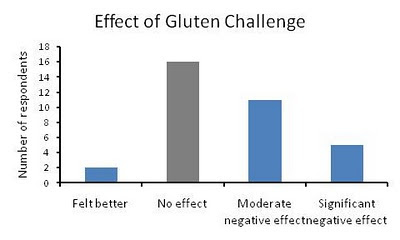
Just under half of participants experienced moderate or significant negative symptoms when they re-introduced gluten at the end of the month. Two people felt better after re-introducing gluten.


Conclusion

I find these results striking. Participants overwhelmingly improved in every health category we measured. Although the data may have been somewhat biased due to the 53% response rate, it's indisputable that a large number of participants, probably the majority, benefited from avoiding gluten for a month. At some point, we're going to compile some of the comments people left in the survey, which were overwhelmingly positive. Here's a typical comment in response to the question " In your own words, how would you describe your January 2011 experience" (used with permission):
Amazing! I would recommend the experiment to anyone. I felt completely more alert, and less bloated. When I ate some gluten at the close of the experiment, I felt gross, bloated, and lethargic.
I think it's worth mentioning that some participants also eliminated other starches, particularly refined starches. Judging by the comments, the diet was probably lower in carbohydrate for a number of participants. We may try to assess that next year.

Jumat, 11 Maret 2011

Favorite Human-Animal Relation Quotes

Designed by Christie Nicole and Adam Weitzenfeld
Thought I'd share some quotes I've encountered  researching Human-Animal relations, ethics, and subjectivity as I pull together a post on the moral psychology of animal encounters. Enjoy!

Stories with animals are older than history and better than philosophy.
--Paul Sheppard

The more I spoke about animals, the less possible it became to speak to them.
--David Abram

Man becomes aware of himself returning the [animal’s] look… [Today] animals are always the observed. The fact that they can observe us has lost all significance... The more we know, the further away we are.
--John Berger

The most matter of fact person could not help thinking of the hogs they were so innocent they came so very trustingly and they were so very human in their protests and so perfectly within their rights... It was like some crime committed in a dungeon all unseen and buried out of sight and of memory... Relentless remorseless it was all his protests... his screams were nothing it it did its cruel will with him as if his wishes feelings had simply no existence at all it cut his and watched him gasp out his life

He had stood and watched the hog-killing, and thought how cruel and savage it was, and come away congratulating himself that he was not a hog; now his new acquaintance showed him that a hog was just what he had been--one of the packer's hogs!...What they wanted from a hog was all the profits that could be got out of him; and that's what they wanted form the working man... What the hogs thought of it, and what he suffered, was not considered; and no more was it with the working man... That was true everywhere under capitalism.
--Upton Sinclair

How many of my ancestors
Were treated like today’s farm animals?
How many of us look the other way?
When I hear of calves
Being taken from their mothers
To be sold as veal
I can hear the wailing voices of mothers
Crying for their babies
As the slave master takes them away
The mother cow breastfeeds the human race
My ancestors breastfed the white race
So when I looked into those stunned eyes today,
No one could have said to me,
‘What’s the big deal?’ ‘ It’s only an animal.’
I could have remembered a time
When someone might have said the same thing about me
--Mary Spears

The possibility of the pogrom is decided in the moment when the gaze of a fatally-wounded animal falls on a human being. The defiance with which he repels this gaze—‘after all, it’s only an animal’—reappears irresistibly in cruelties done to human beings, the perpetrators having again and again to reassure themselves that it is ‘only an animal,’ because they could never fully believe this even of animals
--Theodore Adorno

Men do all they can in order to dissimulate this cruelty or to hide it from themselves, in order to organize on a global scale the forgetting or misunderstanding of this violence that some would compare to the worst cases of genocide (there are also animal genocides)… conditions that previous generations would have judged monstrous, outside of every supposed norm of a life proper to animals that are thus exterminated by means of their continued existence or even their overpopulation.

No one can deny the suffering, fear or panic, the terror or fright that humans witness in certain animals… the response to the question "can they suffer?" leaves no doubt… War is waged over the matter of pity… To think the war we find ourselves waging is not only a duty, a responsibility, an obligation, it is also a necessity … I say "to think" this war, because I believe it concerns what we call "thinking."
--Jacques Derrida

There were seventy of us in a forestry commando unit for Jewish prisoners of War in Nazi Germany… halfway through our long captivity, for a few short weeks before the sentinels chased him away, a wandering dog entered our lives... we called him Bobby, an exotic name, as one does with a cherished dog. He would appear at morning assembly and was waiting for us as we returned, jumping up and down and barking in delight. For him, there was no doubt that we were men... This dog was the last Kantian in Nazi Germany, without the brain needed to universalize maxims and drives
--Emmanuel Levinas

However, even vegetarianism in your hands, would make a capital article... its connection with modern socialism, atheism, nihilism, anarchy and other political creeds... Brussels sprouts seem to make people bloodthirsty, and those who live on lentils and artichokes are always calling for the gore of the aristocracy and for the severed heads of kings... in the political sphere a diet of green beans seems dangerous.
--Oscar Wilde